
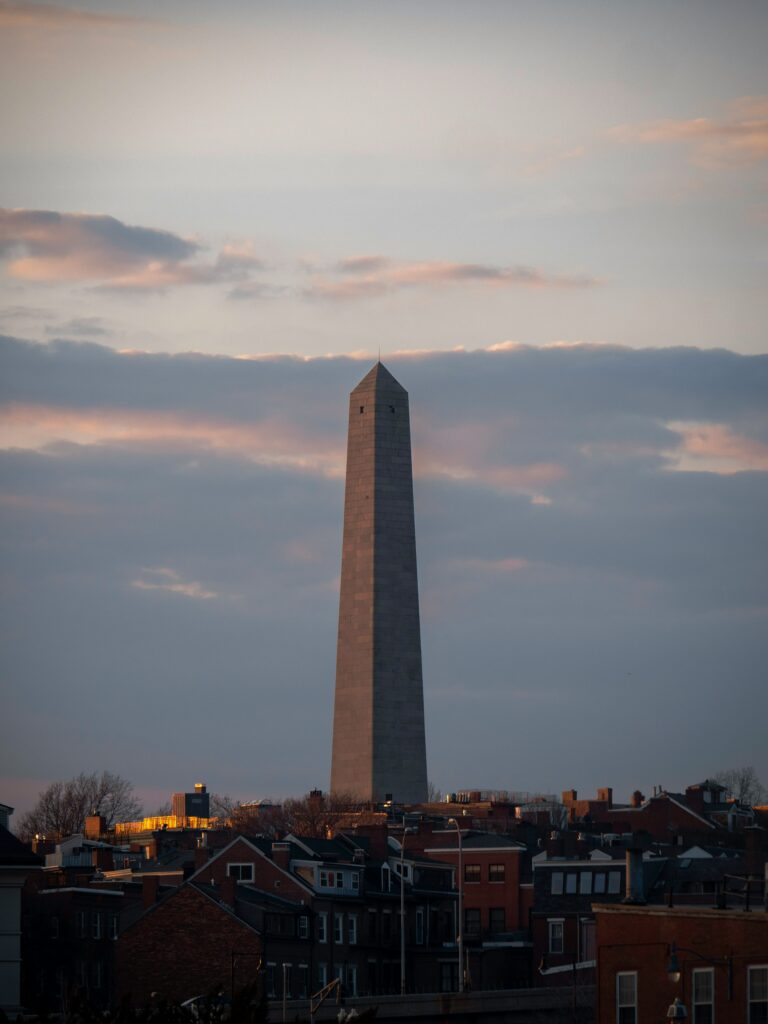
Boston’s oldest neighborhood, Charlestown pairs Revolutionary War landmarks and a historic Navy Yard with tight brick streets, harbor views, and a strong sense of village community.
Across the Charles River to the north of downtown, Charlestown is Boston’s oldest neighborhood and one of its most visually distinctive. Founded in the 1620s, it predates the city itself and once encompassed a much larger territory that included several present-day suburbs. Today, within compact boundaries defined by water and bridges, Charlestown combines significant Revolutionary War sites with tight streets of rowhouses and a growing restaurant scene.
Two landmarks dominate any first impression of Charlestown. The Bunker Hill Monument, an imposing granite obelisk, rises over the neighborhood from Breed’s Hill and commemorates one of the earliest and bloodiest battles of the American Revolution. Down at the harbor, the historic Charlestown Navy Yard anchors the waterfront, now part of Boston National Historical Park. Here you can board the USS Constitution, the world’s oldest commissioned warship still afloat, and explore exhibits that trace centuries of naval history.
Between these anchors, streets like Main Street and Warren Street weave through residential blocks dotted with small parks and squares. Architecturally, Charlestown can resemble a quieter cousin of Beacon Hill, with red brick rowhouses, bay windows, and narrow lanes that date back to the nineteenth century. Yet the mood is more village than showpiece. Local markets, corner bars, and independent cafés serve a community that includes long-established Irish American families, professionals who work in downtown Boston, and newer residents drawn by the neighborhood’s character and views of the harbor.
Over the past few decades, Charlestown has experienced significant reinvestment. Old industrial buildings and parts of the Navy Yard have been converted into housing, offices, and cultural spaces, while waterfront paths and marinas have opened up previously hard-to-reach edges of the neighborhood. At the same time, public housing developments and working-class blocks remain part of the social fabric, creating a complex mix that continues to evolve.
Dining in Charlestown reflects this blend of history and reinvention. Long-running taverns serve classic New England fare in rooms that date to the eighteenth century, while newer restaurants introduce contemporary menus and wine lists. Many of these establishments sit a short walk from historic sites, making it easy to pair a day of walking the Freedom Trail with an evening of relaxed neighborhood dining.
For visitors, Charlestown rewards unhurried exploration. Begin near City Square or the Navy Yard, then make your way uphill along side streets lined with townhouses and pocket gardens. From the top of Bunker Hill you can see much of Boston’s skyline spread across the river. The neighborhood is connected to downtown by the Orange Line, several bus routes, and the scenic Charlestown ferry. It feels close to everything, yet retains a distinct identity rooted in its long history and tight-knit community.
Make a day of it
The Freedom Trail saves its finale for Charlestown — pair the Monument and Navy Yard with the North End just across the bridge.
Explore the neighborhood