
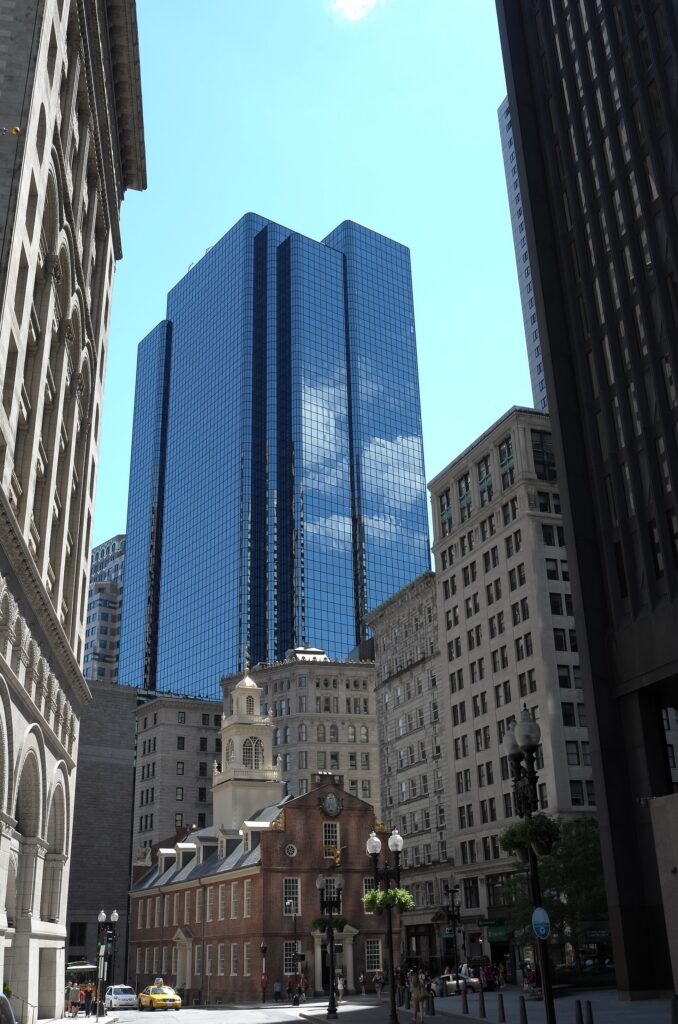
Downtown Boston is the city’s historic and commercial core, where colonial lanes, Freedom Trail landmarks, and glass towers converge around busy plazas and the Greenway.
At the core of the city, Downtown Boston functions as both historic heart and contemporary business district. This is where the colonial town grew along twisting lanes, where the American Revolution gained momentum, and where today glass office towers and shopping arcades rise above some of the oldest streets in the country.
Downtown is best understood as a compact mosaic of micro-districts. Around Faneuil Hall and Quincy Market, historic brick buildings form a pedestrian-friendly cluster that blends retail, food halls, and performance spaces. Here, buskers entertain crowds and visitors follow the Freedom Trail’s red line past landmarks that include the Old State House and the site of the Boston Massacre. To the south, the narrow streets of the Ladder District and the Downtown Crossing retail zone offer a mix of department stores, boutiques, and newer residential towers.
Government Center, with its large plazas and Brutalist city hall, marks a mid twentieth century layer in the urban fabric. Just beyond, the Financial District pushes toward the waterfront with canyons of office buildings that fill during the workday and quiet somewhat in the evening. Throughout, you find small historic sites sandwiched between modern structures, such as historic churches tucked beside high-rises and centuries-old cemeteries that share a block with insurance companies and banks.
In recent decades, Downtown has changed from a nine to five district into a more mixed-use neighborhood. New residential buildings and hotel conversions have brought a stronger evening and weekend presence, while the transformation of the Central Artery into the Rose Kennedy Greenway opened a continuous band of parks along the eastern edge. Food trucks, public art installations, and seasonal markets activate these spaces and draw residents from across the city.
Transit access is virtually unmatched. Several subway lines intersect at Park Street, Downtown Crossing, Government Center, and State Street, while commuter rail and intercity buses arrive at nearby South Station and North Station. For visitors, this means that almost any part of the metropolitan area is reachable from a downtown base. It also means that sidewalks can be crowded at rush hours, which brings a sense of big-city energy to what is, geographically, a compact area.
Staying in Downtown Boston offers immediacy. You can walk to the waterfront, the North End, Beacon Hill, and the Seaport within minutes, and many tours depart from this area. Even if you lodge elsewhere, plan to spend a significant amount of time here, both by day to visit historic sites and by night to see how newer restaurants, theaters, and bars make use of the neighborhood’s evolving character. Downtown may be heavily visited, but it remains an essential part of understanding the city.
Make a day of it
Freedom Trail central — pair Downtown with Beacon Hill uphill or follow the trail into the North End.
Explore the neighborhood