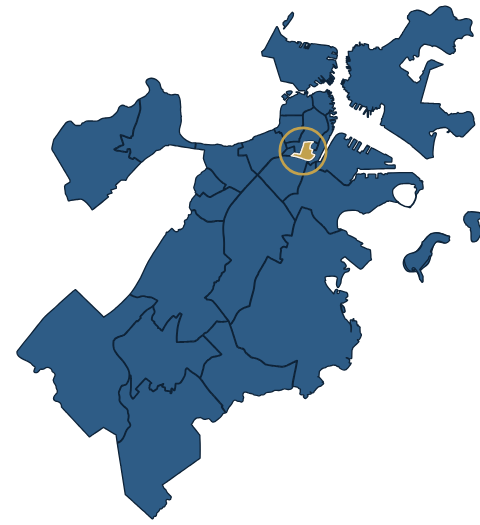
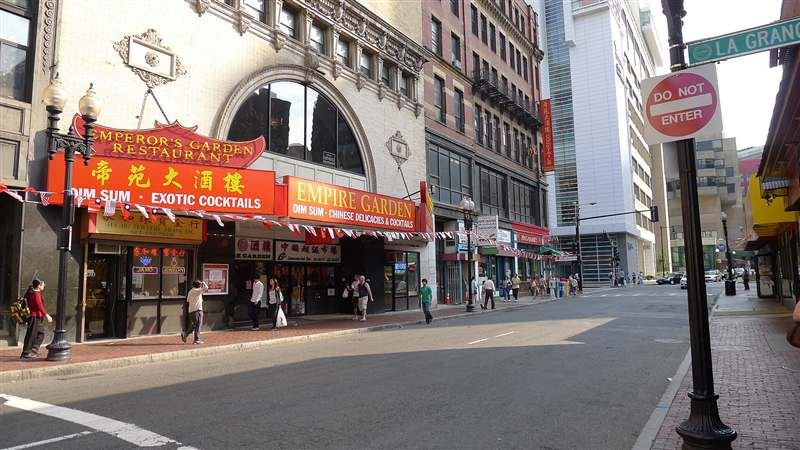
Chinatown packs dim sum halls, bakeries, groceries and a century and a half of history into a few dense blocks between the Theater District and South Station.
Best forDim sum, bakeries, a cheap and good meal before a show, and anyone curious about Boston’s immigrant history.
The feelDense, busy and working. Bilingual signs, sidewalk produce stands and restaurant windows on every block.
Getting thereOrange Line to Chinatown or Tufts Medical Center; Silver Line SL4 to Chinatown Gate; Red Line to South Station; Green Line to Boylston.
From Downtown CrossingAbout 5 minutes on foot down Washington Street, or one stop on the Orange Line.
ParkingStreet meters are few and rarely free. Use a garage on the edges of the neighborhood, or take the T.
Boston’s Chinatown has been a Chinese community since the 1870s and 1880s, and it still works as one: families live above the shops, elders do their marketing on Beach and Tyler streets, and the restaurants cook for the neighborhood first. For visitors, that means good value by central Boston standards, from dim sum carts to bakeries selling buns and egg tarts, within a 5-minute walk of Downtown Crossing and the theaters.
It is small, busy and not especially pretty. There are few formal sights, the sidewalks are narrow, and highway ramps and hospital buildings press in on two sides. Come hungry and curious, not for a museum day.
Getting around
Orange Line: Chinatown station is at Washington and Boylston streets, at the neighborhood’s western edge. Tufts Medical Center, one stop south, is closer to the southern blocks. Both are accessible.
Silver Line: SL4 runs from South Station past Chinatown Gate and down Washington Street; SL5 starts at Temple Place by Downtown Crossing and stops at Tufts Medical Center. Both continue through the South End to Nubian Square.
Red Line and trains: South Station, with the Red Line, Commuter Rail and Amtrak, is about five minutes on foot from the gate across the Greenway.
Green Line: Boylston station is a short walk west, at the corner of Boston Common, but it is not accessible.
Bluebikes: Docks at Chinatown Gate Plaza and the Chinatown T stop.
On foot: Everything is flat and within ten minutes: Downtown Crossing, Boston Common, the Theater District and Bay Village. Sidewalks are narrow and crowded at lunch.
When to go
Weekend mornings bring the biggest crowds and the most energy, mostly for dim sum. Weekday lunches are calmer. Evenings are busy with pre-theater diners, and the neighborhood is a good bet for dinner after a show at the nearby theaters.
Lunar New Year, which falls in late January or February, brings lion dances and celebrations to the streets in the weeks that follow; Chinatown Main Street also stages its own festival. The Chinatown Farmers Market runs from June to October. Check Chinatown Main Street for each year’s dates.
A short history
Chinese immigrants began settling here in the 1870s and 1880s, on streets near the old South Cove waterfront, and opened laundries, shops and restaurants. The community took root despite the Chinese Exclusion Act of 1882, which suspended the immigration of Chinese laborers and was not fully repealed until 1943; the 1965 immigration act brought a new generation of arrivals.
The 20th century took a heavy toll on the neighborhood’s footprint. Highway construction, including the Central Artery in the 1950s and the Massachusetts Turnpike in the 1960s, along with the expansion of what is now Tufts Medical Center and urban renewal, cleared blocks where people had lived and worked. Chinatown held on through family associations, churches, community groups and small businesses, and it remains a center of Chinese American life in the region.
Local tips
Get to dim sum early on weekends, or go on a weekday, when the carts move faster and you can get a table.
Use the gate as your meeting point. It is easy to find from South Station, the Greenway and the SL4.
Walk past the restaurants to the bakeries and groceries on Beach Street and Harrison Avenue. That is where the neighborhood does its daily shopping.
Pair dinner with a show. The Theater District is two to three blocks away.
Address Wall markers at 9 Tyler St, 16 Oxford St, 29 Oak St and other sites, Boston, MA 02111T Chinatown (Orange), 4-minute walkAdmission FreeWebimmigranthistorytrail.com
Chinatown tells its own story on its walls. Since June 2024 the Chinatown Community Land Trust has been mounting markers on its buildings: lenticular photographs that shift as you pass, each with a QR code to archival pictures and recorded memories. The online directory now lists 11 stops. Among them: China Pearl at 9 Tyler Street, where one new arrival found a job on his first day in America; Shanghai Printing at 16 Oxford Street, once the only Chinese printer in Boston; and Parcel C on Oak Street, where a 15-year campaign stopped a parking garage and won a community center.
Other stops remember the garment workers’ union, the 1975 busing fight and Little Syria, the South Cove’s Arabic-speaking settlement before Chinatown. Open the directory on your phone first; the markers are small and easy to walk past.
Tip Go between weekend dim sum and dinner, when Tyler and Oxford streets are at their busiest and the restaurants in the stories are open.
2
Chinatown Gate (Paifang)
NeighborhoodsWorth a visit
Address Beach St at Surface Rd, ChinatownT Chinatown (Orange), South Station (Red)Hours Open 24 hoursAdmission FreeAccess Level plaza at the edge of Chinatown Park; Chinatown station has elevators
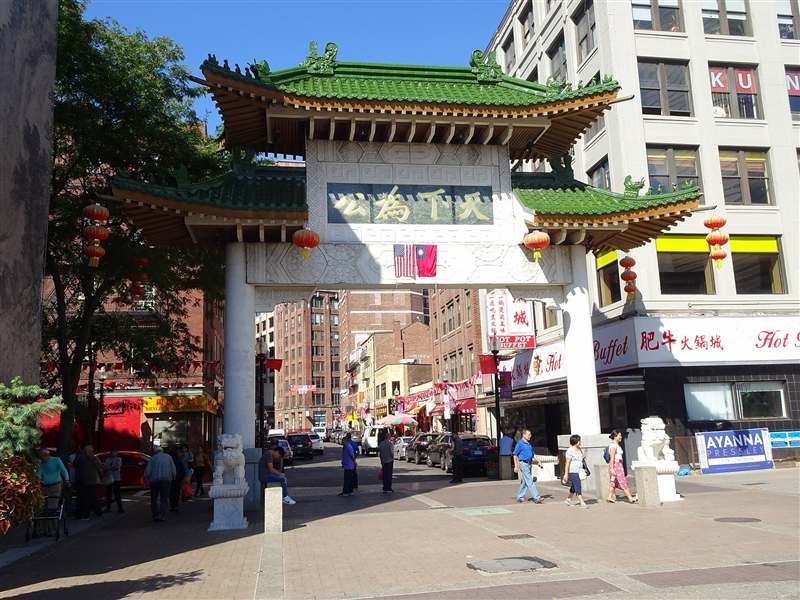
The gate is the front door to New England’s only surviving historic Chinatown. A 1982 gift from Taiwan’s government, installed in 1988, it has a foo lion on each side; the characters facing the Greenway read tian xia wei gong, “all under heaven is for the people,” a phrase associated with Sun Yat-sen.
Beside it, the one-acre Chin Park is the Greenway’s last stretch: a plaza, a serpentine path edged with bamboo and red steel frames, a stream that maps the district, and May Sun’s chessboard in the paving. The park was renamed in 2019 for Frank and Kay Chin, the neighborhood’s Uncle Frank and Auntie Kay. Give it 10 minutes, then walk up Beach Street, waterfront until the 1830s fill, and follow the wall markers of the Immigrant History Trail to Tyler Street, where China Pearl at No. 9 has served dim sum since 1960 and the Quincy School stands at No. 90.
Tip The dim sum rooms fill from late morning on weekends; arrive before 10:30 a.m. for a table without a wait.
3
Quincy School (Chinese Consolidated Benevolent Association)
Historic SitesIf you have time
Address 90 Tyler St, Boston, MA 02111T Chinatown (Orange), 6-minute walkAccess Exterior only; the building is the association’s
The plain brick schoolhouse at 90 Tyler Street changed how American children were taught. Opened in 1847 to a design by Gridley J. F. Bryant, the architect of Old City Hall, and rebuilt to his plans after an 1848 fire, it was Boston’s first graded school: 12 “single-head” classrooms, one teacher and one grade in each. After the Second World War it became the public school for Chinatown’s children, and when it closed in 1976 more than 90 percent of its pupils were Chinese American.
In 1983 the city handed the building to the Chinese Consolidated Benevolent Association of New England, and in 2017 it became Massachusetts’s first National Register listing tied to Asian American history. The interior is the association’s, so look from the street, then walk north past China Pearl at No. 9, a stop on the Immigrant History Trail.
Where to eat
Restaurants in Chinatown
Chinatown keeps late hours: weekend dim sum starts around 10 a.m., and Taiwanese and Cantonese kitchens serve until midnight or later. Most of the cooking is packed into a few blocks of Beach, Tyler, Oxford and Essex streets, with regional Chinese menus beyond the Cantonese classics. Go for weekend dim sum before 10:30 a.m., before the crowds peak, then come back after dark for a second meal.
Run by the Moy family since 1987, this Tyler Street dim sum hall and banquet room reopened in 2024 after a long pandemic closure and a full renovation. Come on a weekend morning, when it opens at 10 a.m., and share har gow, siu mai, steamed char siu bao and salted-egg custard buns. Closed Tuesdays. It takes reservations online, which helps with a group.
B
Hei La Moon
Chinese (dim sum) · $$
83 Essex St, Boston, MA 02111 · T Chinatown (Orange Line), 3-minute walk
One of Chinatown’s big dim sum rooms, now on two floors on Essex Street after leaving its longtime Beach Street home, with carts still circling the dining room. Arrive early on a weekend, before the wait builds, and flag down shrimp har gow, pork siu mai, sticky rice in lotus leaf, chicken feet and baked egg custard tarts. The regular menu covers Cantonese seafood dishes.
C
Winsor Dim Sum Café
Chinese (dim sum) · $$
10 Tyler St, Boston, MA 02111 · T Chinatown (Orange Line), 4-minute walk
The counter-move to the cart halls: there are no carts here, and everything is ordered from a menu and made to order, so dumplings arrive hot. Regulars name the siu mai, har gow, steamed barbecue pork buns, turnip cake and pork-and-century-egg congee. The dining room is up a staircase on Tyler Street. The City of Boston named it a Legacy Business in 2023.
D
Taiwan Cafe
Taiwanese · $
34 Oxford St, Boston, MA 02111 · T Chinatown (Orange Line), 4-minute walk
Boston Magazine named this Oxford Street spot Chinatown’s best neighborhood restaurant twice, calling it one of the first places to introduce Boston to Taiwanese food. Order the oyster omelet with gravy, the roast beef scallion pancake roll and stewed minced pork over rice. It serves until midnight daily, and until 1 a.m. on Fridays and Saturdays.
E
Fuchun Ju
Chinese (Jiangsu and Zhejiang) · $$
55 Beach St, Boston, MA 02111 · T Chinatown (Orange Line), 4-minute walk
Few Chinatown kitchens cook the food of Jiangsu and Zhejiang, the provinces that flank Shanghai, so this light-filled Beach Street room, opened in 2024, stands out; it won Boston Magazine’s 2025 nod as Chinatown’s best neighborhood restaurant. Start with the multicolored soup dumplings, then sweet-and-sour fish and braised lion’s head meatballs. With a group, get the whole Peking duck, which comes in a traditional treasure box with every accompaniment.
F
Peach Farm
Cantonese seafood · $$
4 Tyler St, Boston, MA 02111 · T Chinatown (Orange Line), 4-minute walk
The late-night seafood room, long a favorite of neighbors and restaurant-industry regulars. Order the lobster with ginger and scallions, clams in black bean sauce and the spicy dry-fried salted squid. The founding owners sold in March 2026 after 31 years, and the new owners are keeping the name; call ahead to confirm it has reopened and its late hours. It was named a City of Boston Legacy Business in 2025.
Where to stay
Hotels in Chinatown
30
W Boston
Luxury · $$$
100 Stuart Street, Boston, MA 02116 · T Boylston (Green Line) or Tufts Medical Center (Orange Line)
Access Accessible main entrance; mobility-accessible rooms with roll-in or transfer showers; hearing-accessible rooms and kits; TTY
The W opened in October 2009 in a 26-story tower on Stuart Street, with condominiums upstairs and the Wang and Shubert theaters around the corner. Its design leans on Boston rebels from Aerosmith to Edgar Allan Poe, and the W Lounge pours cocktails before and after the show.
31
Courtyard Boston Downtown
Mid-range · $$
275 Tremont Street, Boston, MA 02116 · T Tufts Medical Center (Orange Line)
Access Accessible main entrance; mobility-accessible rooms with roll-in or transfer showers; hearing-accessible rooms and kits; TTY
Built in 1925 as the headquarters of Boston’s Elks Lodge No. 10 and later run as the Bradford Hotel, this 13-story building sits across Tremont Street from the Wang and Shubert theaters. The renovated rooms are standard Courtyard, but the ballroom survives, and the top floor, now premium rooms, once held the building’s supper clubs.
32
HI Boston Hostel
Value · $
19 Stuart Street, Boston, MA 02116 · T Chinatown (Orange Line) or Boylston (Green Line)
Access Elevator; no other accessibility details published
Hostelling International rebuilt the six-story Dill Building into this hostel, which opened in 2012 on Stuart Street between the Theater District and Chinatown. Dorm beds and private ensuite rooms share common rooms, a good fit for solo travelers and anyone saving their budget for the shows and dumplings nearby.
33
DoubleTree by Hilton Hotel Boston – Downtown
Mid-range · $$
821 Washington Street, Boston, MA 02111 · T Tufts Medical Center (Orange Line)
Access Accessible public entrance; mobility-accessible rooms, including two-queen rooms with roll-in showers and kings with tubs; TTY; visual alarms
This DoubleTree occupies the former Don Bosco High School on Washington Street, where Chinatown meets the Theater District, beside Tufts Medical Center and its Orange Line stop. It suits theatergoers and hospital visitors who want a big-brand room. There is a Starbucks in the building, and Wisteria serves breakfast and dinner. Parking is valet only, at $65 a night.
EXPLORE BOSTON
That’s your 6 free pages this month
Keep exploring — it’s free. Join 8,500+ readers who get our daily Boston email, and this device unlocks right away.