Why go
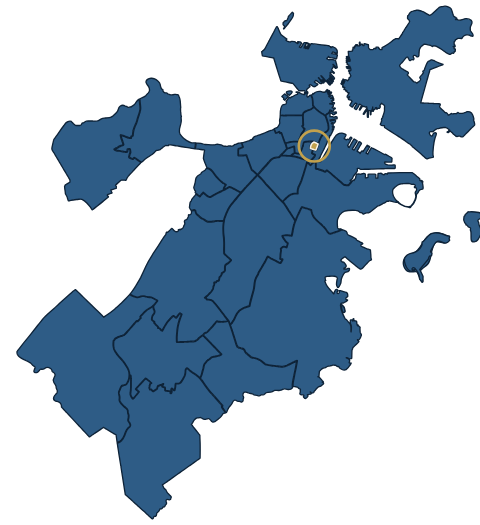
The Leather District is one of Boston’s smallest neighborhoods. The City counts it as nine blocks, roughly bounded by Essex Street, Atlantic Avenue, Kneeland Street and Lincoln Street, just east of Chinatown. There is no single attraction here. What you get is a remarkably intact run of late-19th-century commercial buildings, five and six stories of brick with big ground-floor display windows set in cast-iron columns, and a quiet that is rare this close to a major train station.
Come if you like buildings, want a proper meal near South Station, or have an hour to fill between trains. If you want a full day of sights, treat the Leather District as a half-hour detour attached to Chinatown, the Greenway or the museums across Fort Point Channel, not a destination on its own.
Getting around
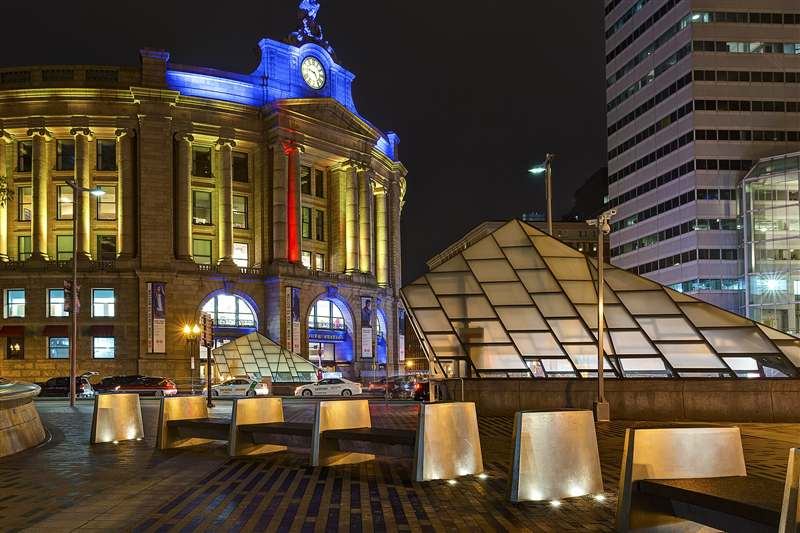
South Station is the main door: Red Line; the Silver Line’s SL1 to Logan Airport, SL2 and SL3; eight Commuter Rail lines; and Amtrak. Chinatown station on the Orange Line is a few blocks west. Bluebikes has docks at South Station and at Atlantic Avenue and Beach Street.
The district is flat and compact, and you can walk its length in about five minutes. The edges are the hard part: Atlantic Avenue, Surface Road and Kneeland Street carry heavy traffic to and from the highway ramps, so use the signals. Street parking is metered and scarce; the South Station Bus Terminal garage is the closest option.
When to go
Weekdays are the liveliest, with office workers filling the lunch spots. Weekends and evenings are quiet, which is good for photographs and less good if you are counting on a particular café, so check before you go. The brick reads best in late-afternoon light. The Greenway’s fountains, including the Chinatown stream, typically run from late May through mid-October.
A short history
The Leather District stands on made land: it was part of the South Cove tidal flats until they were filled in the 1830s. After the Great Boston Fire of 1872 destroyed much of the downtown business district, Boston’s shoe and leather trade regrouped here, and most of today’s buildings went up between the 1880s and about 1920. South Station opened next door in 1899.
The district was listed on the National Register of Historic Places in 1983. By then the leather trade was fading, and since the 1980s the warehouses have filled with offices, studios and residential lofts, giving the neighborhood the mixed-use character it has today.
Local tips
- Early for a train? Cross Atlantic Avenue from South Station and loop South Street and Lincoln Street. Fifteen minutes here beats fifteen minutes in the concourse.
- Pair it with Chinatown for food. The choice there is far wider, at every price.
- The Dewey Square end of the Greenway has lawn and benches, which makes it the place to sit with a coffee.
- If you are walking to the Seaport, use the Congress Street or Summer Street bridge across Fort Point Channel.