
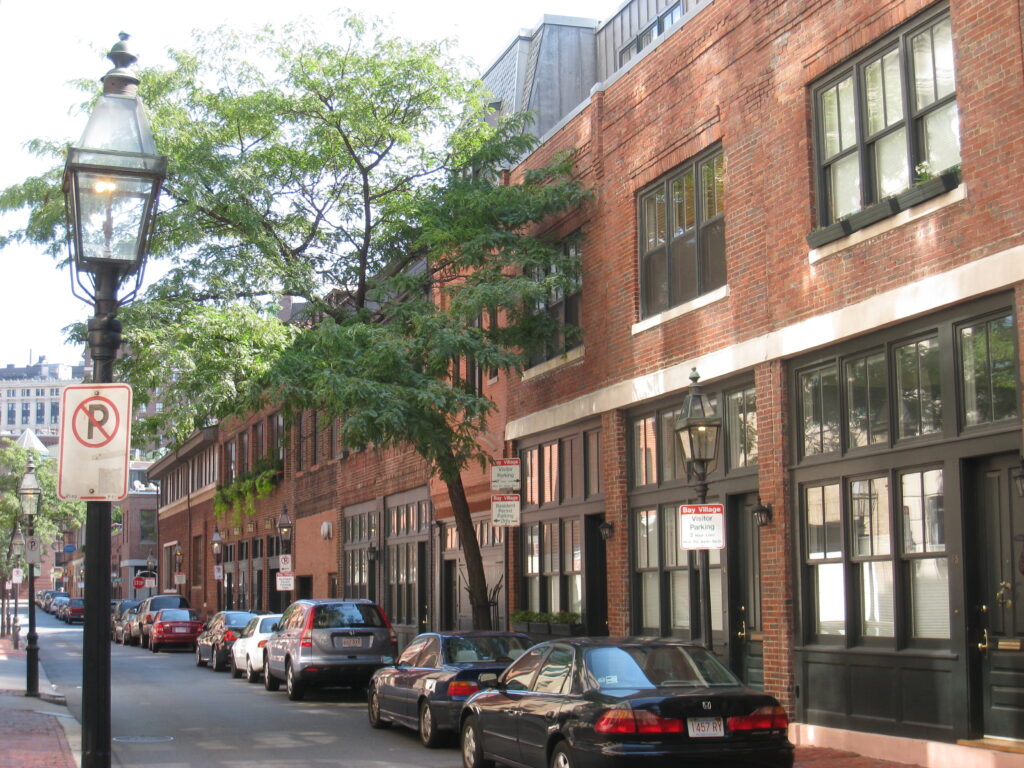
A tiny brick enclave hidden in the center of the city, Bay Village feels like a miniature Beacon Hill, with gas lamps, bow-front rowhouses, and remarkably quiet streets.
Tucked between Back Bay, the South End, the Theatre District, and the Leather District, Bay Village is one of Boston’s smallest neighborhoods and one of its easiest to overlook. That is precisely its charm. Often described by the city as a “secret-garden” district, Bay Village is a compact grid of brick rowhouses, gas lamps, and narrow streets that feels like a quiet pocket of old Boston sitting in the middle of downtown.
The neighborhood’s architecture immediately stands out. Many houses resemble a scaled-down version of Beacon Hill’s townhomes, complete with bow fronts, decorative iron railings, and dormer windows. The effect is intimate and domestic rather than grand. Streets are short and tree-lined, with modest brick sidewalks and planters outside front doors. At night, the combination of brick, lamplight, and the relative absence of through-traffic makes Bay Village feel surprisingly peaceful given its location.
Historically, this area developed in the early nineteenth century on filled land, at a time when Boston was expanding rapidly. Craftspeople and builders who worked on larger Beacon Hill homes are said to have constructed smaller versions for themselves here, which gives Bay Village its distinctive “mini-Beacon Hill” character. Over time the neighborhood has seen waves of change, including periods when it was associated with the theater community and later with Boston’s LGBTQ+ nightlife, in part due to its proximity to the Theatre District and the former Combat Zone.
Today Bay Village is almost entirely residential, with only a scattering of small businesses, corner cafés, and local services inside its narrow boundaries. Most of the commercial energy lies just beyond its edges along Stuart, Tremont, and Arlington streets, where theaters, hotels, and restaurants cluster. This physical separation from busier blocks helps preserve Bay Village’s village-like mood; you are only a few minutes’ walk from major performance venues and the Boston Common, yet the streets feel worlds away once you step back inside the neighborhood grid.
For visitors, Bay Village is less about a checklist of attractions and more about atmosphere. It is a lovely area for an evening stroll after dinner or a matinee, and it rewards slow wandering. Look up at rooflines and cornices, notice how some buildings lean at slightly odd angles, and imagine what it was like when carpenters and stagehands walked home from nearby theaters two centuries ago. If you stay in one of the hotels that border the neighborhood, Bay Village quickly becomes a familiar shortcut and a welcome contrast to the bright lights and traffic just beyond.
In practical terms, its central location is a major asset. From Bay Village you can walk to Back Bay Station for regional trains, access multiple subway lines, or reach the Public Garden, Chinatown, the South End, and the Financial District within fifteen minutes on foot. Travelers who appreciate quiet streets but want to remain in the middle of the city’s cultural life will find this pocket of Boston particularly appealing.
Make a day of it
Tiny Bay Village slots neatly between Chinatown dumplings and a South End dinner — see all three in one evening on foot.
Explore the neighborhood