
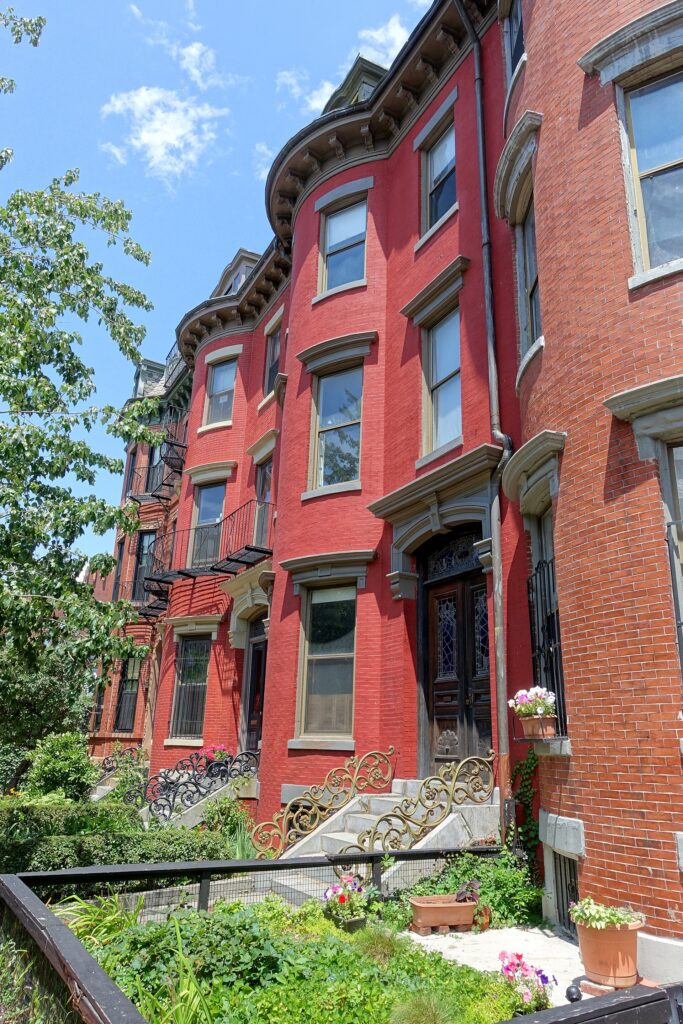
The South End is Boston’s grandest Victorian neighborhood — a sweep of red-brick bowfront houses, leafy garden squares, and one of the city’s best dining and gallery scenes.
Laid out in the mid-19th century on filled tidal land, the South End is, by common reckoning, the largest intact Victorian row-house district in the United States. Its blocks of bowfront houses rise over residential squares modeled on those of London — Union Park, Worcester Square, Rutland Square, and Chester Square among them — each a pocket of wrought-iron fences, magnolias, and front-stoop conversation.
For all its formal architecture, the South End wears its history of reinvention openly. After decades of mid-20th-century decline it became one of the city’s great urban-revival stories, and it has long been among Boston’s most diverse and creative quarters — historically a center of the city’s Black cultural life and jazz scene, and for generations the heart of its LGBTQ community. That layered past gives the neighborhood a character distinct from the more buttoned-up Back Bay just across the tracks.
Today the South End is best known for two things: food and art. Tremont Street, Washington Street, and Shawmut Avenue form one of Boston’s densest restaurant rows — bistros, bakeries, and cocktail bars tucked into garden-level storefronts — and the neighborhood is a perennial contender for the city’s best dining. Just south, the SoWa district (short for “South of Washington”) has turned a cluster of former industrial buildings into a hub of galleries, design studios, and makers. From May through October, the open-air SoWa Open Market and its food trucks, vintage market, and farmers’ stalls draw crowds every Sunday, with First Fridays opening the gallery doors after dark.
Landmarks anchor the wandering. The Cathedral of the Holy Cross on Washington Street is the largest Catholic church in New England; Blackstone and Franklin Squares face each other across the avenue as a pair of formal Victorian parks; and the Southwest Corridor Park threads a long ribbon of greenway and bike path along the neighborhood’s edge.
Getting here is easy: the Orange Line stops at Back Bay and Massachusetts Avenue, the Silver Line runs along Washington Street, and the South End sits within an easy walk of Back Bay, Bay Village, and Chinatown. Come for a long lunch and a gallery crawl, or simply to wander the squares — few Boston neighborhoods reward an unhurried afternoon as well as this one.
Make a day of it
Brunch, then SoWa’s galleries and market — the South End pairs on foot with Back Bay or tiny Bay Village. Where to eat in the South End →
Explore the neighborhood