
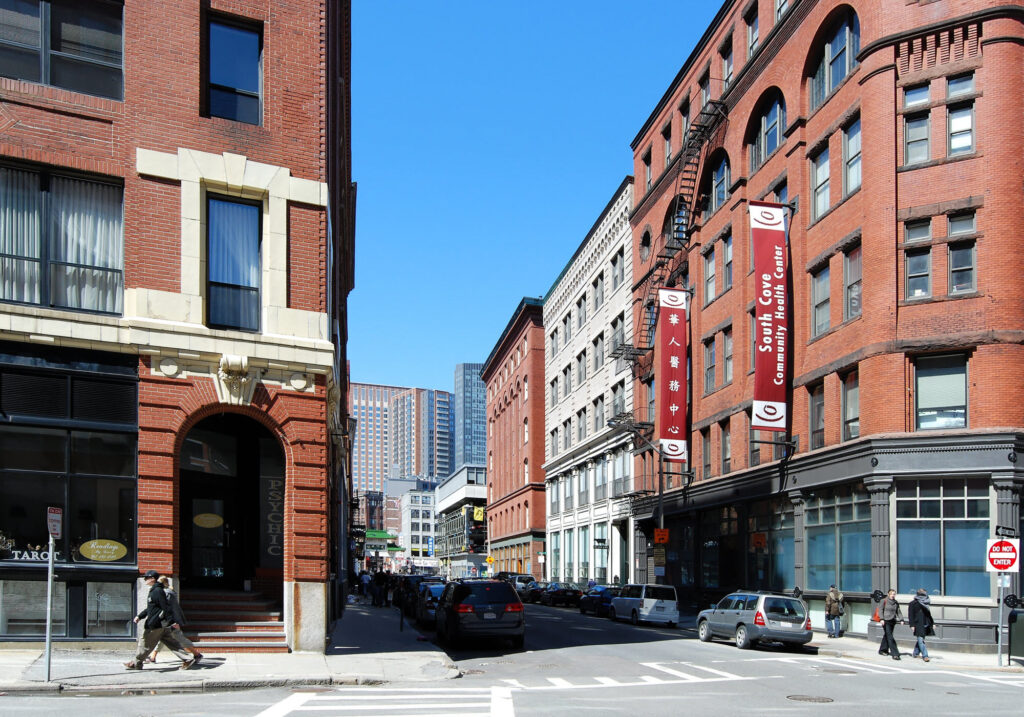
The Leather District is Boston’s nine-block warehouse-and-loft pocket by South Station—brick, cast iron, big windows, and a quiet industrial beauty.
The Leather District is one of Boston’s smallest neighborhoods—a tight, nine-block enclave just east of Chinatown, tucked between Dewey Square and Kneeland Street. It’s easy to miss if you’re moving fast, but if you slow down for even ten minutes, the architecture does all the talking.
This is Boston in sturdy materials: late-19th-century warehouse buildings with thick brick façades, oversized windows, and old commercial ground floors designed for display. Many storefronts are framed by cast-iron columns—details that instantly signal the district’s industrial past.
Much of the neighborhood’s character dates to the era after the Great Boston Fire of 1872, when the city rebuilt commercial blocks with more fire-resistant construction. The Leather District became a center for the leather and shoe trades, and the buildings that remain still feel purpose-built for that practical, working Boston economy.
In the late 20th century, the district began shifting into the mixed-use neighborhood it is today. Since the 1980s, the Leather District has grown into a blend of residential lofts and commercial tenants—one reason it’s often associated with classic “brick-and-beam” city living.
Location is the Leather District’s superpower. South Station anchors the edge of the neighborhood, so you’re steps from one of the region’s biggest transit hubs—perfect if you want downtown access without the nonstop intensity of larger neighborhoods.
The best way to experience the Leather District is simply to wander: look up at cornices and old signage, notice the scale of the windows, and take in how quickly the city changes from Chinatown’s neon-and-restaurant energy to these calmer, warehouse-lined streets. It’s a micro-neighborhood, but it’s one of Boston’s most visually distinctive.