
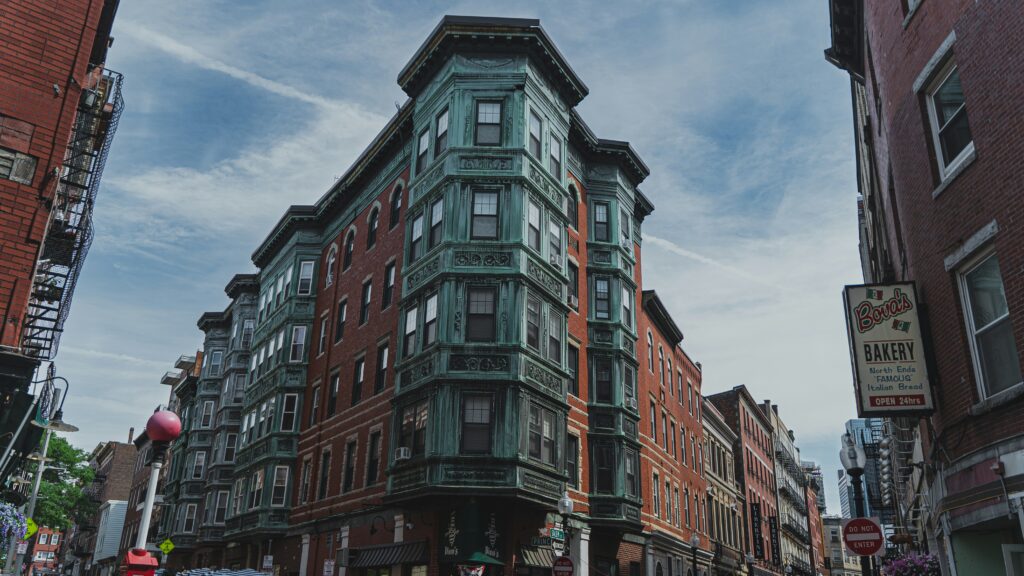
The North End, Boston’s Little Italy, is a tangle of narrow streets, historic churches, and beloved pastry shops and trattorias that stay lively late into the evening.
Jutting into Boston Harbor just north of downtown, the North End is one of the city’s oldest continuously inhabited neighborhoods and one of its most visited. Often referred to as Boston’s Little Italy, it is famous for narrow lanes, closely packed brick buildings, and a dense concentration of Italian restaurants and bakeries.
The North End began as an early colonial settlement, and its waterfront location made it a gateway for generations of immigrants. In the nineteenth and early twentieth centuries, Irish, Jewish, and other European groups passed through, but it was Italian immigrants who ultimately left the strongest mark. By the early twentieth century, Italian families dominated the area, opening groceries, bakeries, tailor shops, and later restaurants that served the community and eventually attracted visitors from across the region.
Today, Hanover Street functions as the main spine of the neighborhood. Cafés and restaurants with sidewalk seating line the busy thoroughfare, while side streets such as Salem, Prince, and Fleet hold smaller trattorias, pasticcerias, and specialty shops. In the evening, the scent of garlic, espresso, and baking bread fills the air. Even as some long-time businesses yield to newer concepts, the essential rhythm of the street remains: locals stopping to chat in Italian or English, servers carrying plates of pasta through open doorways, and tourists trying to decide which pastry line seems shortest.
The North End is also rich in historic sites. The Old North Church, famous for its role in Paul Revere’s midnight ride, stands near the northern tip of the peninsula. Paul Revere’s House, one of the oldest structures in downtown Boston, is tucked into a side street not far away. Copp’s Hill Burying Ground offers a quiet, elevated vantage point with views of Charlestown and the Zakim Bridge. These landmarks link the neighborhood’s immigrant history to the broader story of the American Revolution.
Religious and cultural festivals remain central to North End life. In summer, several Catholic feasts honor patron saints with processions, music, food stalls, and lights that transform the streets into outdoor celebrations. The Feast of Saint Anthony and the Fisherman’s Feast are among the best known and draw large crowds from across the region.
For visitors, the North End is easy to reach on foot from downtown or via the Green and Orange Lines at Haymarket and North Station. It is an ideal place to combine history and dining in a single outing. Walk in via the Rose Kennedy Greenway, explore historic sites, then settle into a café for espresso and cannoli. The neighborhood can be crowded, especially in peak tourist season and on warm weekend evenings, but that energy is part of its appeal.
Make a day of it
Cannoli and Old North first, then pair the North End with Charlestown across the bridge to finish the Freedom Trail — or drift down the Harborwalk into the Wharf District. Where to eat in the North End →
Explore the neighborhood