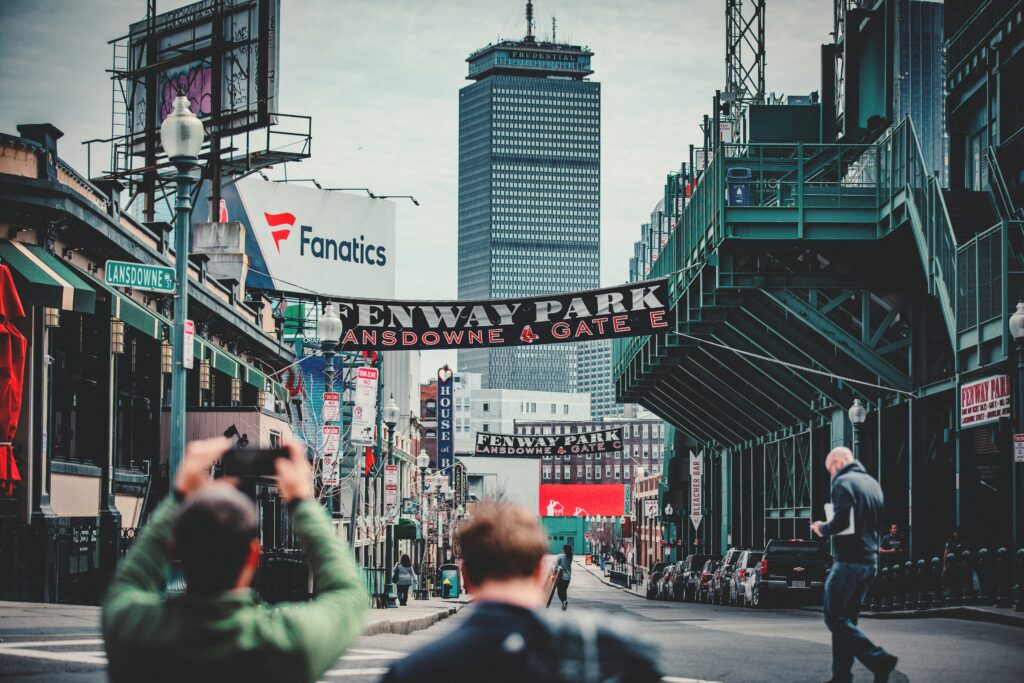
Home to Fenway Park, world-class museums, and thousands of students, Fenway–Kenmore is where baseball, culture, and campus life meet around leafy parkland.
To the west of Back Bay and just south of the Charles River, Fenway – Kenmore is a neighborhood where sports, education, museums, and new residential towers meet in tight proximity. Its name immediately brings to mind Fenway Park, the storied home of the Boston Red Sox, yet the district encompasses much more, including major cultural institutions and one of the highest concentrations of students in the city.
Kenmore Square acts as a gateway. For decades the large Citgo sign that looms over the square has served as a visual landmark not only for baseball fans but for anyone navigating this side of the city. Streets radiate from Kenmore toward Boston University, toward Back Bay, and south toward the museum district, carrying a continuous flow of pedestrians, buses, and cars.
Fenway Park sits a short walk from the square, tucked tightly into a residential and commercial grid in a way that feels very different from modern suburban stadium complexes. On game days, the surrounding streets fill with fans headed to sports bars, seafood joints, and sausage stands, while vendors call out to sell caps and scorecards. Even when no game is scheduled, tours of the ballpark and a growing lineup of concerts and events keep the area active.
South of the park, the neighborhood transitions into what is often called the Fenway Cultural District. The Museum of Fine Arts, Boston and the Isabella Stewart Gardner Museum occupy prominent sites along the Back Bay Fens, a historic park designed as part of Frederick Law Olmsted’s Emerald Necklace system. These institutions draw art lovers from around the world and provide a contemplative counterpoint to the energy of the ballpark.
The Fens themselves combine marsh, formal gardens, athletic fields, and walking paths. Once an unsanitary tidal flat, this area was reshaped into a series of linked parklands that help manage stormwater and provide much-needed open space for surrounding neighborhoods. In spring and summer, community gardens and rose beds fill with color, while in winter the broad views of the skyline across bare trees have their own charm.
Fenway – Kenmore is also a major educational hub. Boston University edges the northern boundary along Commonwealth Avenue, while institutions such as Northeastern University, the Berklee College of Music, and Emmanuel College cluster nearby. As a result, students are everywhere, and many local businesses cater to them with relatively affordable eateries, music venues, and services that stay open late.
In recent years, major new development has transformed sections of the neighborhood into high-rise residential and mixed-use districts. Glassy towers, new retail spaces, and improved streetscapes have given parts of the area a more contemporary feel, sometimes in tension with the older building stock and long-time residents. For visitors, this means a wider range of lodging and dining choices within walking distance of both cultural institutions and the ballpark.
Choose Fenway – Kenmore if you want a base that combines easy access to Back Bay and the Longwood Medical Area with its own strong attractions. Whether you are here to see a game at one of America’s most celebrated ballparks, to spend a day among world-class art collections, or simply to enjoy the greenery of the Fens, this neighborhood delivers an intense and very Boston mix of experiences in a relatively small area.
Vibe: Sporty and cultural; home to the Red Sox, major museums, and a large student population, all framed by Olmsted parkland.
Pros:
- Fenway Park, the MFA, and the Gardner Museum in a compact area.
- Back Bay Fens and the Emerald Necklace provide generous green space.
- Excellent transport via the Green Line and buses.
- Lively dining and bar scene, particularly around the ballpark and campuses.
Cons:
- Game days bring heavy crowds, noise, and traffic.
- Large student population creates a transient feel in some streets.
- Rapid development has raised both rents and hotel rates.
- Fewer quiet residential corners for travelers seeking calm.
