
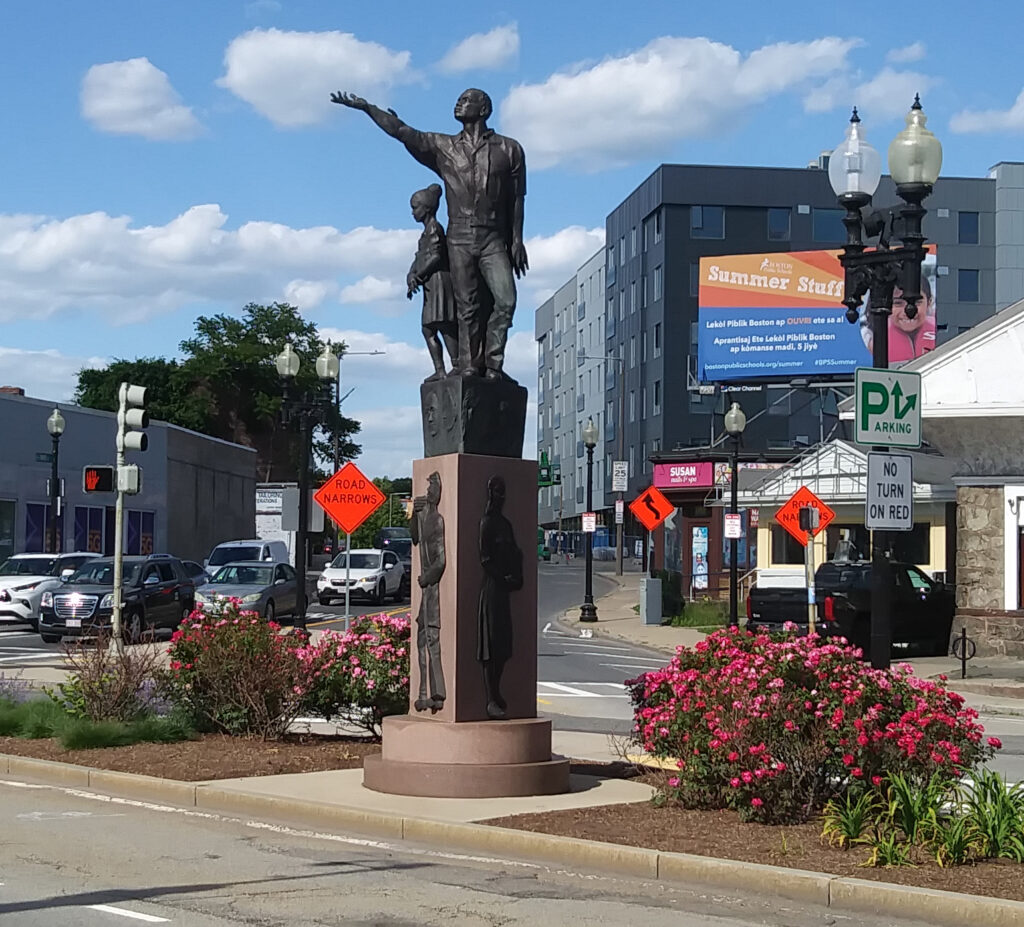
Mattapan is a center of Boston’s Black and Caribbean life, with Blue Hill Avenue’s churches, markets, and eateries reflecting deep Haitian and West Indian roots.
South of Dorchester and Roxbury, Mattapan stretches along Blue Hill Avenue and the Neponset River as one of Boston’s most culturally rich and historically significant neighborhoods. Originally a streetcar suburb with many Jewish residents in the early twentieth century, Mattapan is now best known for its large African American and Caribbean communities, particularly its vibrant Haitian population.
The neighborhood’s main commercial artery is Blue Hill Avenue. Along this broad boulevard and nearby side streets, storefront churches, hair salons, bakeries, takeout counters, and small groceries serve local residents in multiple languages. Signs advertising Haitian, Jamaican, and other Caribbean goods and services sit beside American chain stores and long-standing local businesses. The result is a streetscape that reflects migration patterns from the 1960s to the present, when new arrivals from the Caribbean and Africa made Mattapan a center of Boston’s Black diaspora.
Residential Mattapan is characterized by modest single-family homes, two- and three-family houses, and small apartment buildings. Many houses have yards and mature trees. Compared with denser inner neighborhoods, the streets feel more open, and there is often a sense that neighbors have known one another for decades. At the same time, like many parts of Boston, Mattapan has experienced economic challenges, and some blocks show the effects of disinvestment and foreclosure waves from the early twenty-first century.
The Neponset River forms Mattapan’s southern boundary and has become an important recreational and environmental resource. Multi-use paths follow the river, connecting to greenway projects in nearby Milton and Dorchester. These trails give residents and visitors a safe place to walk and cycle away from traffic, and they highlight the role of the river in shaping the neighborhood’s landscape.
Community life in Mattapan centers on churches, cultural organizations, and civic groups that work on issues such as public safety, youth development, and economic opportunity. Festivals and events celebrate Haitian Flag Day, Caribbean music, and African heritage. Food is a major part of local culture; visitors can seek out Haitian griot and rice, Jamaican patties, and other dishes that are difficult to find elsewhere in the city.
For travelers, Mattapan offers an authentic experience of contemporary Boston that is far removed from the Freedom Trail. It is not a district of grand monuments, but a place where everyday life and global cultures intersect. The Mattapan trolley, a light rail line that uses historic PCC streetcars, connects the neighborhood to the Red Line at Ashmont Station, while bus routes and nearby commuter rail stops link it to downtown. A visit here rewards curiosity about how Boston’s neighborhoods continue to change and diversify.
Make a day of it
Ride the Mattapan trolley — pair Mattapan Square’s Caribbean bakeries with Dorchester’s Ashmont end of the line.
Explore the neighborhood