
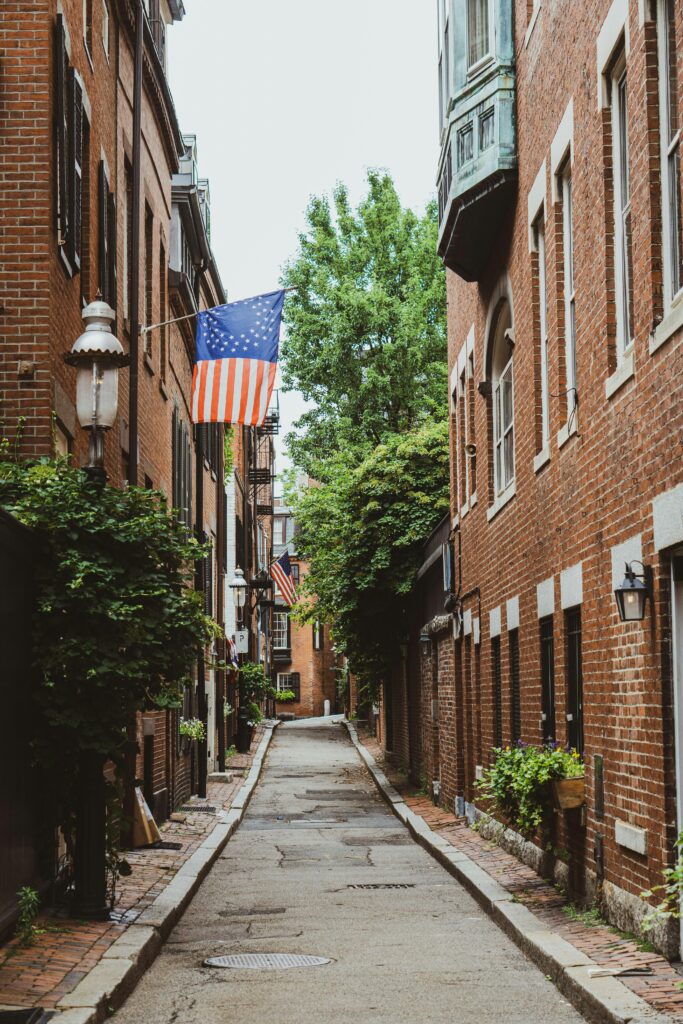
Beacon Hill is Boston’s storybook hillside, all red brick, gas lamps, and cobblestone, crowned by the gleaming State House and steeped in political and abolitionist history.
Perched just north of the Public Garden and west of downtown, Beacon Hill is Boston’s most romantic historic neighborhood, a tightly packed hill of brick townhouses, gas lamps, and cobbled alleys that seems almost unchanged from the nineteenth century. The Massachusetts State House, with its gilded dome, crowns the hill and announces that this is both a political and a symbolic heart of the city.
Beacon Hill developed in stages. The south slope, facing the Common, became one of Boston’s most prestigious residential addresses in the early 1800s, home to merchants, politicians, and professionals who built elegant townhouses along streets like Mount Vernon and Chestnut. The north slope, facing toward today’s West End and North Station, followed a different path and became a center of Boston’s free African American community in the nineteenth century, as well as a home for immigrants and working people. This contrast between slopes still shapes the neighborhood’s history tours and walking routes.
Architecturally, Beacon Hill is remarkably cohesive. Buildings are typically three to five stories tall, constructed of warm red brick with black shutters and decorative ironwork. Streets are narrow and often climb steeply, and the sidewalks are sometimes made of brick or even original granite slabs. Acorn Street, a tiny cobblestone lane frequently described as one of the most photographed streets in the United States, condenses many of these elements into a single atmospheric view.
Despite its historic preservation, Beacon Hill is not frozen in amber. Charles Street at the base of the hill functions as the neighborhood’s main commercial strip, lined with independent boutiques, antique shops, cafés, and small restaurants. On weekends, residents and visitors browse bookshops, pick up specialty foods, and linger over brunch on sidewalk patios. The combination of local shops and everyday services, such as pharmacies and markets, means that Beacon Hill operates as a true neighborhood rather than only a tourist district.
The area is rich in sites connected to political and social history. In addition to the State House and the Boston Common, Beacon Hill includes the Black Heritage Trail, which connects former homes, churches, and meeting halls associated with the free Black community and the abolitionist movement. Guided walks from organizations such as Boston By Foot explore both the elegant townhouses of the south slope and the more modest but historically significant buildings of the north slope, highlighting how these communities interacted.
For travelers, Beacon Hill offers two different experiences. If you stay in a nearby hotel or guesthouse, it provides an atmospheric base within walking distance of downtown, the North End, the Charles River Esplanade, and Back Bay. Even if you are staying elsewhere, it is worth planning at least half a day here. Start with a loop through the Common and Public Garden, climb Park Street or Beacon Street to the State House, then wander across the hill on Chestnut and Mount Vernon before dropping down to Charles Street for coffee or shopping.
More than any single monument, the real attraction of Beacon Hill is the overall sense of place. The steep streets, the glow of gas lamps on winter evenings, the flash of the State House dome from unexpected angles, and the feeling that you are walking through layers of Boston history all at once are what make this neighborhood one of the city’s most enduring images.
Make a day of it
Do Beacon Hill’s gaslit lanes in the morning, cross the Common for Downtown’s Freedom Trail stops, and finish among Back Bay’s brownstones.
Explore the neighborhood