
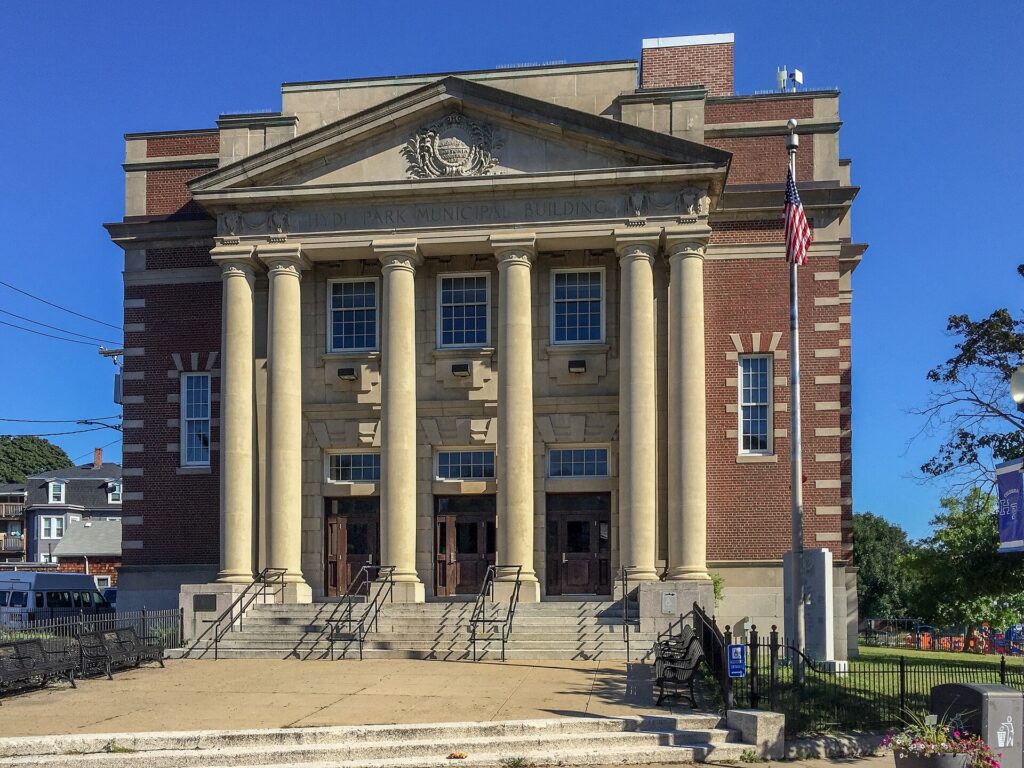
At Boston’s southern edge, Hyde Park feels like a small town, with a traditional main street, riverfront parks, and quiet residential streets that read more suburban than urban.
At the southern edge of Boston, Hyde Park feels like the city’s back porch. This is Boston’s southernmost neighborhood, a place where the Neponset River bends through low hills and tree-lined streets, and where many homes have yards, driveways, and porches that look more suburban than urban. Annexed to Boston in 1912, Hyde Park retains a strong sense of its former town identity, complete with a traditional main street and a cluster of civic buildings that could belong to a small New England community.
Cleary Square and Logan Square form the commercial heart of the neighborhood. Here you find a compact business district of storefronts, restaurants, and services that draw residents from surrounding streets. The architecture mixes early twentieth century brick blocks with wood-frame houses and church spires in the background. There is a modest, grounded feel to the place. Many businesses are family owned, and it is common to see people greeting one another by name on the sidewalk.
Residential Hyde Park spreads out in several directions from this core. Fairmount Hill climbs above the river with a mix of Victorian and early twentieth century houses, some with broad porches and generous lots. Other sections consist of tight knit side streets of multifamily homes that echo the triple-decker pattern seen elsewhere in Boston, although the spacing between buildings can feel more generous. The Readville area in the southeast retains traces of older industrial uses near rail yards, along with clusters of workers’ housing.
Green space is one of Hyde Park’s strongest assets. The Neponset River Reservation and nearby Stony Brook Reservation provide miles of woodland trails, ponds, and playing fields. On weekends you will see families fishing along the river, joggers on wooded paths, and youth sports teams using local fields. These parks reinforce the neighborhood’s reputation as a part of Boston that delivers city services within a more relaxed, leafy setting.
Transit links have long shaped Hyde Park’s relationship to the rest of the city. Commuter rail stations at Hyde Park, Fairmount, and Readville connect residents to South Station in under twenty minutes, while bus routes feed into the Orange and Red Lines. For many, this means a daily rhythm that alternates between a busy downtown job and an evening on a quieter street where crickets rather than sirens form the night soundtrack.
For visitors, Hyde Park is less a bucket list destination than a glimpse of how many Bostonians actually live. It is a good place to see the city’s more suburban side, to walk along the river, or to explore local bakeries and Caribbean or Latin American restaurants that reflect the neighborhood’s diverse population. If you are staying nearby or exploring the Neponset corridor, a short detour into Hyde Park offers a change of pace and a reminder that Boston includes spaces where city and suburb blend.
Make a day of it
On Boston’s southern edge, pair Hyde Park’s Neponset greenway with West Roxbury’s Millennium Park or Roslindale’s square.
Explore the neighborhood