
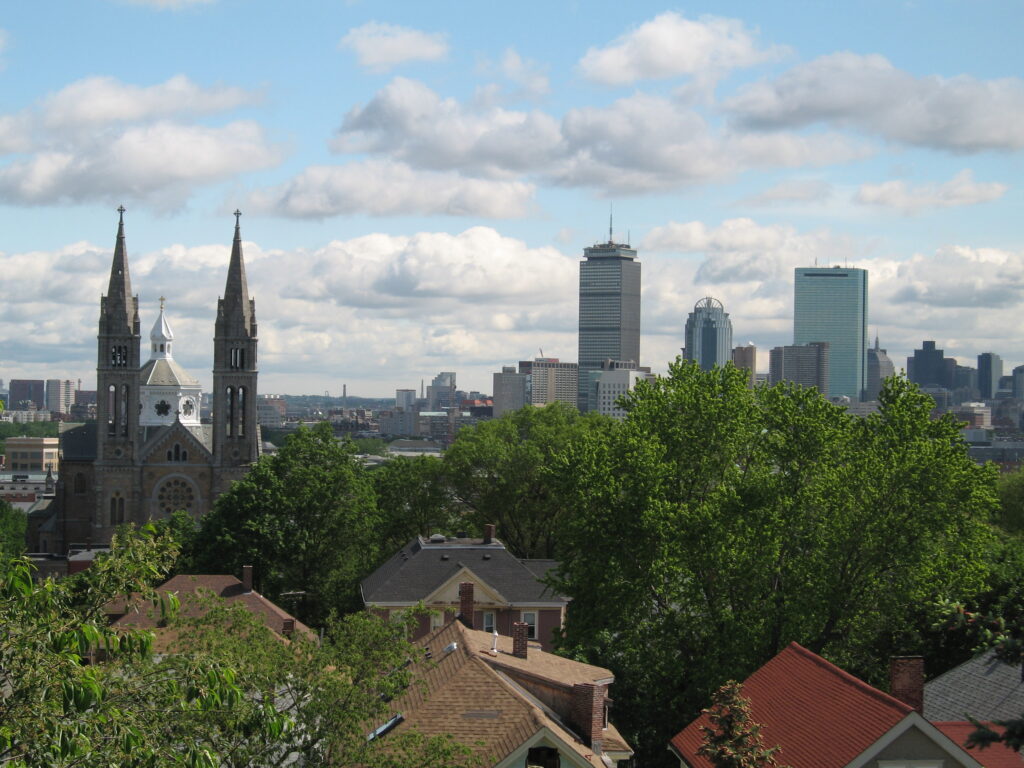
Compact and steep, Mission Hill offers dramatic city views, brick rowhouses, and triple-deckers, all within walking distance of major hospitals, museums, and universities.
Rising sharply west of Roxbury and just south of the Longwood Medical Area, Mission Hill is a compact neighborhood with a big presence on the skyline. Its steep streets, triple-decker houses, and distinctive brick apartment blocks give it a dramatic profile, while its location near major hospitals and universities makes it one of Boston’s most convenient and diverse places to live.
Mission Hill takes its name from the Basilica and Shrine of Our Lady of Perpetual Help, popularly known as the Mission Church, whose twin towers dominate the hill and can be seen from many parts of the city. Around the church, tight streets such as Smith Street and Parker Hill Avenue climb and curve, revealing views of downtown and the Back Bay skyline between rows of houses. Walking here can feel like hiking in an urban village; almost every route involves a slope, a stairway, or a surprising vista.
Historically, the neighborhood developed in the nineteenth and early twentieth centuries as a working- and middle-class residential district. Granite quarries and breweries once operated nearby, and many residents worked in those industries or in the growing medical and educational institutions close by. Housing ranges from wood-frame triple-deckers to brick rowhouses and distinctive brick apartment buildings known locally as “Boston apartments,” with bow fronts and small courtyards.
Today, Mission Hill’s population is a blend of long-time residents, hospital staff, graduate students, and young professionals. The neighborhood’s proximity to the Longwood Medical Area, home to world-renowned hospitals and research institutions, keeps demand for housing high. At the same time, community advocates have worked to preserve affordability and protect the interests of families and lower-income residents.
Tremont Street and Huntington Avenue frame much of Mission Hill’s commercial life. Brigham Circle is a busy node where a supermarket, shops, and restaurants serve both local residents and the hospital community. Side streets contain smaller businesses, including cafés, pubs, and takeout spots that reflect the neighborhood’s diversity. Portions of the Southwest Corridor Park, a linear park created along a former highway route, pass just to the west, offering bike paths, playgrounds, and green space that link Mission Hill to the South End and Jamaica Plain.
For visitors, Mission Hill can be an intriguing place to explore on foot, especially if you enjoy neighborhoods with strong topography and everyday street life. Climb to one of the hilltop parks for wide views of the city, then drop down to Tremont Street for a casual meal. The Green Line and Orange Line both pass nearby, and several bus routes cut through the neighborhood, so it is easy to combine a visit to Mission Hill with time in the museums of the Fenway or the medical area.
Make a day of it
Pair Mission Hill’s pubs and triple-deckers with Longwood’s museums or Jamaica Plain’s green space down the parkway.
Explore the neighborhood