
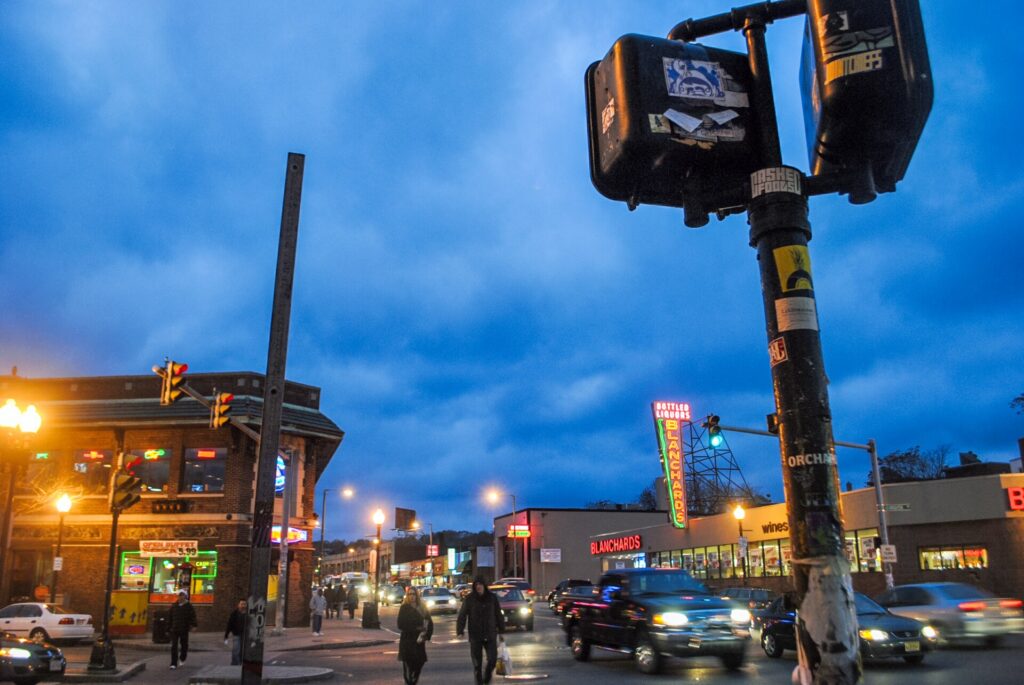
Youthful and creative, Allston is Boston’s bohemian crossroads, packed with students, global eateries, street art, and live music venues that keep the neighborhood buzzing late into the night.
In Boston’s northwest corner along the Charles River, Allston feels like the city’s permanent adolescence: energetic, creative, and always in motion. Officially recognized as one of Boston’s 23 neighborhoods, Allston is closely linked with Brighton, yet it has a personality all its own that is shaped by students, immigrants, and an enduring live-music culture.
Harvard Avenue and Brighton Avenue form the commercial backbone of the neighborhood. By day you see a steady flow of commuters, students with backpacks, and locals running errands; by night, neon signs glow over crowded sidewalks as people move between noodle shops, Korean barbecue, Brazilian cafés, Mexican taquerias, and pizzerias that stay open into the small hours. Food is one of Allston’s main attractions. The area is widely considered Boston’s closest equivalent to a Koreatown, with Harvard and Brighton avenues lined with restaurants serving tabletop barbecue, bubbling stews, contemporary Korean fusion, and some of the city’s best fried chicken.
Allston has long been a launchpad for bands and artists. Small venues and bars host live music most nights of the week, from indie rock and punk to jazz and experimental sounds. Even as the neighborhood evolves, projects like the planned return of the legendary Great Scott in a new mixed-use development keep live performance at the center of local identity. Colorful murals brighten brick walls and alleyways, and you can easily spend an afternoon exploreing new street art on side streets you have never walked before.
Because of its proximity to Boston University, Harvard’s athletic complex, and easy Green Line and bus connections, Allston’s population skews young. Triple-decker houses are carved into shared apartments, and every September brings the famous “Allston Christmas,” when departing tenants leave unwanted furniture and books on the curb for the next wave of residents to claim. The result is a neighborhood that feels intensely lived-in and constantly refreshed.
Yet Allston is more than student apartments and dive bars. Residential pockets around Ringer Park and toward the river have a quieter, more settled feel, with families pushing strollers, residents walking dogs, and longtime homeowners chatting on porches. Small, practical businesses such as hardware stores, auto garages, and barbershops remind visitors that this is also a working-class neighborhood where people build their daily lives, not only a campus extension.
For visitors, Allston works best if you enjoy raw energy and local flavor more than polish. It is an excellent base if you want quick access to downtown while staying somewhere that feels distinctly Boston but not overly curated. Spend a day wandering Harvard Avenue, sampling dumplings and banchan, browsing vintage clothing and record shops, and end the night with a show in a venue small enough that you may one day say you saw that band before everyone else. Allston rarely sits still, which is exactly what keeps it interesting.
Make a day of it
Pair Allston’s rock clubs and cheap eats with next-door Brighton for a full day on the B Line, or cross the river toward Fenway–Kenmore for a game night. Where to eat in Allston →
Explore the neighborhood