
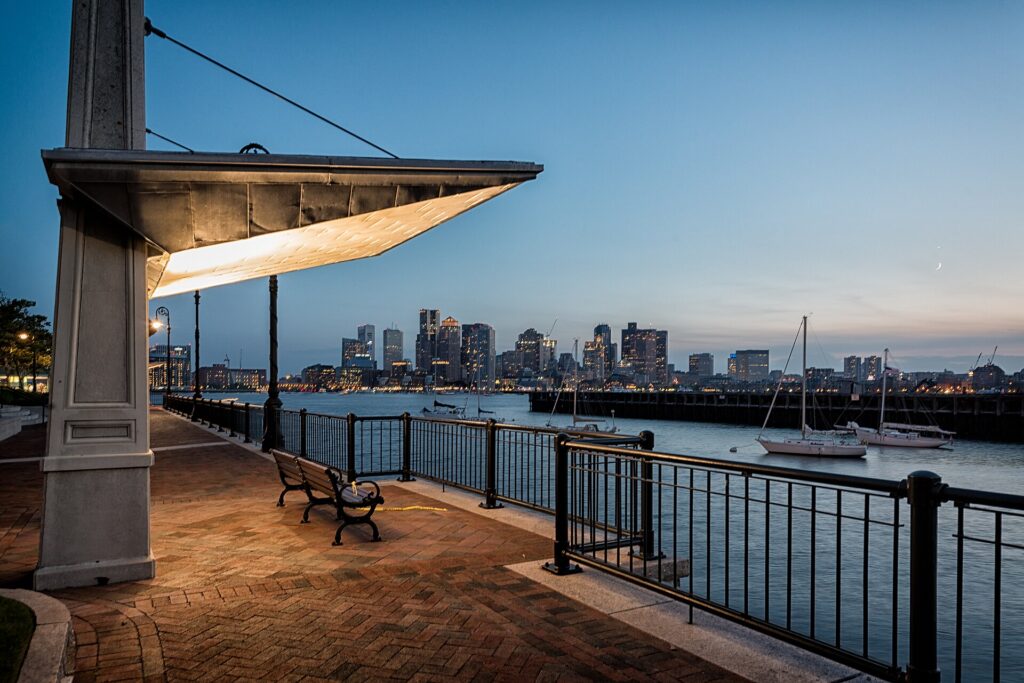
Across the harbor from downtown, East Boston mixes old shipyards, Logan Airport, and hillside triple-deckers with Latin American restaurants and waterfront parks overlooking the skyline.
Across Boston Harbor from downtown, East Boston spreads across a series of connected peninsulas that combine residential streets, parks, and Logan International Airport. Once a center of shipbuilding and home to many European immigrant communities, it is now one of the city’s most dynamic neighborhoods, with strong Latin American influences and increasingly prominent waterfront development.
The neighborhood’s history is tied closely to the harbor. In the nineteenth century, East Boston’s shipyards produced famous clipper ships and its docks received waves of newcomers arriving by sea. Later, the creation and expansion of Logan Airport reshaped its geography and economy. Residential districts such as Maverick, Jeffries Point, Eagle Hill, and Orient Heights grew around this infrastructure and retain distinct identities, with variations in housing types, street patterns, and elevations.
Today, East Boston is known for its diversity and relatively accessible housing compared with some other waterfront areas. Many residents trace roots to Central and South America, especially to countries such as El Salvador and Colombia, and this is reflected in the local restaurant landscape. Along Meridian Street, Bennington Street, and smaller side streets you will find pupuserias, Peruvian rotisserie chicken shops, and bakeries that sit alongside traditional Italian eateries and newer café concepts.
The waterfront has become a major draw. At Piers Park, landscaped lawns and viewing platforms frame sweeping views back toward the downtown skyline, especially atmospheric at sunset. Additional green spaces and Harborwalk extensions continue to open, creating a nearly continuous route along sections of the shore. Artists’ studios, mixed-use residential complexes, and a growing number of eateries have occupied former industrial properties, giving the waterfront a feeling of transition and possibility.
Transportation shapes daily life here. The Blue Line runs from downtown through several East Boston stations and continues to Revere, making trips into the city center relatively quick. Vehicular access relies heavily on tunnels under the harbor, which can be congested at peak times, yet for many residents the neighborhood’s walkability and transit service reduce the need for daily driving.
For travelers, East Boston can function either as a convenient base near the airport or as a destination in its own right. Staying here offers fast access to flights while still giving you the feel of a real neighborhood, complete with corner stores, small parks, and locals chatting on stoops. Even if you are not flying, a ferry ride or short Blue Line trip from downtown brings you to views and dining options that feel fresh and somewhat removed from the city’s usual tourist routes. East Boston tells a story of Boston that begins with wooden ships and continues through the jet age into a future that is increasingly shaped by its multicultural community.
Make a day of it
Piers Park has the skyline view — pair Eastie’s taquerias with a quick Blue Line hop to the Wharf District and the Harborwalk. Where to eat in East Boston →
Explore the neighborhood