
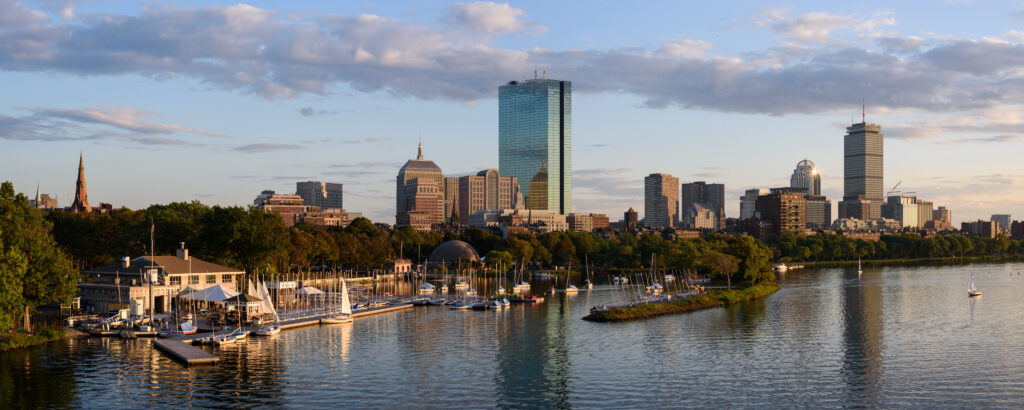
The mansions and brownstones of Back Bay form one of the best-preserved collections of Victorian-era urban architecture in the United States. Built largely between the 1850s and 1880s on land reclaimed from the tidal flats of the Charles River, the neighborhood was laid out by architect Arthur Gilman on a French-inspired grid of wide, tree-lined avenues — a plan strongly influenced by Haussmann’s Paris. Block after block of Italianate, Second Empire, and French Renaissance facades give the area its remarkable visual unity.
Commonwealth Avenue is the showpiece, a grand 240-foot-wide boulevard with a planted central mall, lined by some of the city’s tallest and most ornate rowhouses, originally built for Boston’s wealthiest families. The architecture is protected today by the Back Bay Architectural Commission. Strolling the parallel residential streets — Marlborough, Beacon, and Newbury among them — is free and self-guided. The MBTA Green Line runs beneath Boylston Street, with several Back Bay stops.
Good to know
- One of the largest intact areas of Victorian residential architecture in the U.S.
- Built on filled land between roughly the 1850s and 1880s on a Paris-inspired grid
- Commonwealth Avenue’s tree-lined central mall is the neighborhood’s showpiece
- Mostly private homes; enjoy the architecture on a free, self-guided walk
Getting there
- Address: Commonwealth Ave and surrounding Back Bay streets (e.g., Marlborough, Beacon, Newbury), Boston, MA 02116
- Neighborhood: Back Bay
- Nearest T: MBTA Green Line stops along Boylston St (Arlington, Copley, Hynes Convention Center); Back Bay station (Orange Line/commuter rail) nearby